
Online EMDR Therapist & Counsellor — UK & International
Pete Tobias Counselling
Specialist Online EMDR Therapy Across the UK
When the past continues to shape the present, life can begin
to feel stuck.
Perhaps you've reached a point where something needs to
change. You may be in crisis, have been triggered by something that has brought everything rushing back, or have spent months—even years—trying to understand why the past continues to affect your life.
Whatever has brought you here, you're not alone.
Sometimes we consciously or unconsciously continue
responding to the past long after events have ended. For some people this happens through intrusive memories or flashbacks.
For others it may be less obvious, showing itself through emotions, bodily sensations, panic, irritability or a persistent sense of being on guard without fully understanding why.
These are not signs of weakness. They are survival responses—your nervous system doing exactly what it learnt to do in order to protect you.
Given the right conditions, our brains and nervous systems
are capable of processing experiences that have become stuck. EMDR offers a way of working with these experiences, helping them become integrated into your life story rather than continuing to shape how you experience yourself and the
world around you.
Whether you're in crisis, concerned about being triggered again, or ready to begin making sense of your experiences, I provide specialist online EMDR therapy to adults across the UK as an EMDR Europe Accredited Practitioner and BACP Accredited Counsellor, helping you access experienced EMDR support wherever you live.


How Online EMDR Therapy Can Help
EMDR (Eye Movement Desensitisation and Reprocessing) is an evidence-based psychotherapy that helps people process experiences which continue to affect them in the present.
If you're new to EMDR, you can learn more about how it works before deciding whether it's right for you.
The aim of EMDR isn't simply to help difficult experiences feel less distressing. It's to help them become integrated into your sense of self, so they no longer remain emotionally or physically 'stuck'. You may still remember what happened, but it no longer feels as though it is happening now.
This isn't about forgetting or pretending difficult experiences didn't happen. It's about allowing your brain and nervous system to process what was left unresolved, so those experiences become integrated into your life story rather than continuing to shape your present.
How I Approach EMDR
In my experience, recent traumatic experiences often sit on
earlier unresolved experiences. Sometimes those roots lie in childhood, while for others therapy begins following a single event, such as a road traffic accident or medical trauma. As therapy unfolds, we may discover connections that weren't previously apparent. Together, these experiences can continue to shape how we experience ourselves, other people and the world around us.
If you'd like to understand more about how trauma continues to affect us long after events have passed, I've explored this in more detail here.
EMDR recognises that our brains have an innate capacity to
process and integrate experiences when the right conditions exist. My role isn't to force that process, but to work alongside you, creating the conditions that support your brain's own capacity to integrate what has been left unresolved.

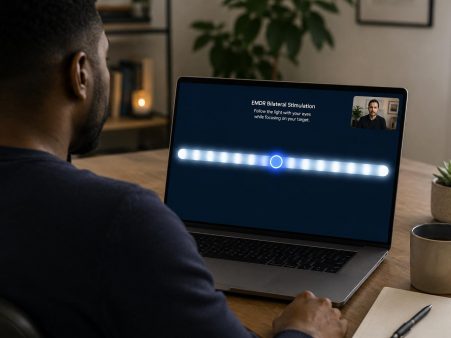
What Happens During an Online EMDR Session
Every person's therapy is different, but EMDR usually follows a structured process that is adapted to your individual needs and pace.
Getting to know you
We begin by understanding what has brought you to therapy, how your experiences
continue to affect you today and what you're hoping will change. Together, we'll decide whether EMDR is the right approach for you.
Preparation
Before any trauma processing begins, we focus on helping you feel ready. This may include developing grounding strategies, strengthening internal resources and ensuring you feel confident with the EMDR process. We only move forward when the foundations are in place.
Processing
When you're ready, we'll begin processing the experiences that continue to affect you. During this stage, bilateral stimulation may be delivered using eye movements, sounds or tactile stimulation, depending on what works best for you. We move at a pace that feels manageable, regularly checking in throughout.
Integration
As therapy progresses, many people notice that difficult memories begin to feel different. They may still remember what happened, but it no longer carries the same emotional or physical intensity. The aim isn't to erase the past, but to help it become integrated into your life story so it no longer continues to shape your present.
What Working Together Looks Like
Every person's experiences are different, so therapy begins
with understanding your story rather than assuming what you need.
Before beginning EMDR, we take time to understand what has
brought you here, how your experiences continue to affect you today and whether EMDR is the right approach for you. Together, we build the foundations needed for the work ahead.
I see therapy as a collaborative process. My role isn't to
push you forward or leave you to work things out alone, but to work alongside you, adapting our work as your understanding develops and supporting you at a pace that feels right for you.
The therapeutic relationship is an important part of
therapy, but it isn't the therapy itself. My role is to create the conditions that support your brain's own capacity to process and integrate what has been left unresolved.
There is no expectation that you'll revisit every detail of
difficult experiences or move faster than feels manageable. We'll regularly review how things are progressing and adapt our approach to your needs.
If you're autistic or ADHD, you may find it helpful to read how I adapt EMDR for neurodivergent adults. Click here for Autistic adults and here for ADHD adults.


Why Online EMDR Works
Many people wonder whether online EMDR can really be as effective as meeting in person. It's a reasonable question.
Research has shown that online EMDR can be just as effective
as in-person EMDR for many people. In my experience, the quality of therapy is shaped far more by the therapeutic relationship, how we work together and howtherapy is adapted to your needs than by whether we're sitting in the same room.
For many people, working from home actually makes therapy easier. A familiar environment can reduce the stress of travelling, while allowing you to access specialist online EMDR therapy wherever you live in the
UK.
Online EMDR can be delivered using visual, auditory or tactile bilateral stimulation, depending on what works best for you. If adjustments help you engage more comfortably, we'll make them. Whether that's taking breaks, using the chat function, reducing eye contact or switching your
camera off, therapy is adapted around you—not the other way around.
If you're interested in the evidence, I've summarised the research comparing online and in-person EMDR.
Online EMDR Intensives
For some people, weekly 50-minute sessions aren't the way they want to work. Online EMDR Intensives offer another option: extended sessions that allow us to focus on a specific experience, pattern or theme over a shorter period of time.
The additional time means we can stay with the therapeutic work for longer, rather than being limited by the usual end of a therapy hour. This can be particularly useful when there is a clearly identified area you want to focus on and you have the time and emotional readiness to engage in a more concentrated piece of work.
An intensive isn't about trying to process everything at once or moving faster than feels manageable. Assessment and preparation remain an important part of the process, and we work collaboratively to identify the focus and make sure the foundations are in place before beginning the intensive itself.
I currently offer online EMDR Intensives, including a single-day intensive with preparation sessions beforehand and a follow-up session afterwards.

Still Have Questions About Online EMDR?
Deciding whether to begin EMDR is an important step, and it's natural to want to understand more than simply whether it works. You might be wondering what an online session actually feels like, whether it's possible to build a genuine therapeutic relationship through a screen, or how to know if you've found the right EMDR therapist.
If you'd like to explore these questions further, you may find these articles helpful:
- What Is It Like to Have EMDR Therapy Online?
- Can You Build a Therapeutic Relationship Online?
- Choosing the Right EMDR Therapist: Questions Worth Asking
Together, they explain what to expect from online EMDR, how I work, and the factors I believe are most important when beginning EMDR.
Why Work With Me
Choosing a therapist is an important decision. Alongside
professional training and experience, it's equally important to find someone you feel comfortable working with.
I'm an EMDR Europe Accredited Practitioner and a BACP
Accredited Counsellor, providing specialist online EMDR therapy for adults across the UK. My work is informed by current research, ongoing professional development and regular clinical supervision.
I've also experienced EMDR as a client myself. I understand
what it feels like to place your trust in another person and to engage in the therapeutic process. While your experiences will never be the same as mine, that perspective helps me appreciate what it means to sit on both sides of the therapeutic relationship.
Whether you're seeking support following a single traumatic
event or working through experiences that have developed over many years, we'll work together at a pace that feels right for you.
Therapy is adapted around you—not the other way around.
If you'd like to know more about my background and therapeutic philosophy, you can read more about me here.




“Working with Pete, I was finally able to process my past trauma and truly accept myself. I'm deeply thankful.”
Client M
You May Still Have Some Questions...
What if I'm not sure EMDR is right for me?
That's okay. Beginning therapy doesn't mean committing to EMDR. We first take time to understand what has brought you here, how your
experiences continue to affect you and what you're hoping will change. If EMDR seems appropriate, we can decide that together. If it doesn't, we'll talk about what might.
What if I don't know what to say?
You don't need to arrive knowing where to begin. If having more structure feels helpful, we can work that way. You're welcome to email me a few questions or thoughts before our complimentary 15-minute consultation, and we can use those as a starting point during our conversation. We simply begin wherever feels most manageable.
What if I want to turn my camera off during the session?
That's absolutely okay. Some people find that reducing visual demands helps them think more clearly or feel more comfortable. You can let me know beforehand, use the chat function if that's easier, or simply turn your camera off during the session. I won't assume anything is wrong or ask you to switch it back on. We'll work in the way that allows you to engage most comfortably.
What if online therapy doesn't feel the same as meeting in person?
Many people wonder that before their first session. Building a meaningful therapeutic relationship doesn't depend on being in the same room.
What matters is feeling understood, working collaboratively and creating the right conditions for therapy. Many people are surprised by how connected they feel online and appreciate being able to engage in therapy from an environment that already feels familiar.
Take The Next Step
Reaching out for therapy is often the first sign that something is already beginning to change. It takes courage to ask for help,
particularly when you're feeling overwhelmed, stuck or uncertain about what comes next.
If you're wondering whether EMDR could help, I invite you to
book a complimentary 15-minute consultation. It's an opportunity for us to meet, explore what has brought you here and discuss whether working together feels like the right fit. There's no obligation to begin therapy afterwards.
Whether you're in crisis, concerned about being triggered again, or simply ready to understand your experiences more deeply, you don't have to navigate it on your own.
Online EMDR Therapy — Frequently Asked Questions
What is the difference between EMDR and counselling?
Counselling tends to work through talking — exploring your thoughts, feelings, relationships, and experiences in depth. EMDR is more structured and less focused on verbal processing. Rather than analysing what happened, it helps your nervous system and memory networks actually process it differently, using bilateral stimulation. Some talking is still part of the work, but it's not the main mechanism of change.
What is the difference between EMDR and CBT?
CBT primarily focuses on identifying and changing patterns of thinking and behaviour. EMDR focuses on helping the brain process distressing experiences and memories that continue to influence current difficulties. Both are evidence-based — they just work in fundamentally different ways.
What does bilateral stimulation mean?
Bilateral stimulation refers to alternating left-right stimulation — such as eye movements, tapping, or sounds — used as part of the EMDR process. It's what makes EMDR distinctive, and it can be delivered in several ways depending on what feels most comfortable for you.
Why do people choose EMDR therapy?
People often choose EMDR because it's an evidence-based approach that can help process difficult experiences, reduce emotional distress, and create lasting change — particularly when other approaches haven't quite reached the root of things.
Can EMDR help when talking therapy hasn't worked?
This is one of the most common reasons people come to EMDR, and it makes complete sense. You can spend years understanding why something affected you and still feel the weight of it in your body and emotions. EMDR works differently — it helps the brain process experiences that have become "stuck," rather than analysing them from the outside. Many people find it reaches places that conversation alone couldn't.
What do I need for online EMDR therapy?
Just a device with a camera and microphone (laptop or tablet), a stable internet connection, and a private space where you won't be interrupted. Before your first session I'll send you simple guidance on how to set up your space so you feel safe, comfortable, and ready to begin.
Is online EMDR available internationally?
Yes. Online EMDR sessions are available to clients across the UK and internationally. If you're based outside the UK and would like to check availability in your location, get in touch and I'll be happy to help.
What EMDR Can Help With:
Can EMDR help with childhood trauma?
Yes, and this is one of the areas where EMDR really comes into its own. Whether you experienced neglect, emotional or physical abuse, bullying, loss, or other painful experiences growing up, EMDR can help you process the lasting effects of those years — not just understand them, but genuinely feel differently about them.
Is EMDR effective for complex trauma?
Complex trauma — sometimes called relational trauma or complex PTSD (C-PTSD) — differs from single-incident PTSD in important ways. Where PTSD typically develops in response to one or more discrete traumatic events, complex trauma usually arises from prolonged, repeated experiences — often in the context of relationships, such as childhood neglect or abuse, domestic violence, or chronic emotional harm.
EMDR is a versatile psychotherapy that can be carefully adapted to work effectively with complex trauma. Rather than following the standard EMDR protocol used for single-incident trauma, working with complex trauma typically requires a longer preparation phase — building internal resources, developing a strong therapeutic relationship, and ensuring the nervous system can tolerate the processing work before it begins.
When this groundwork is in place, EMDR can be a highly effective approach for complex trauma — helping to process the layered, interconnected memories and beliefs that often underpin C-PTSD presentations.
Can EMDR help with emotional abuse and neglect?
Yes. The long-term effects of emotional abuse, neglect, criticism, rejection, and painful relational experiences can run very deep — affecting self-esteem, relationships, and how you feel about yourself day to day. EMDR can help process those experiences at their root, rather than just managing the symptoms. EMDR can also be combined with relational cousnelling to work on developmental gaps and rupture and repair.
Can EMDR help with difficult childhood experiences?
Yes. EMDR can help process experiences from childhood that continue to influence emotions, beliefs, relationships, and behaviour in adult life — even experiences that are hard to name or fully articulate
Can EMDR help with shame and low self-worth?
Yes, and this is deeply important work. Shame and low self-worth often have roots in specific experiences — things that were done or said, or that we concluded about ourselves as a result. EMDR can help address those experiences directly, supporting a shift toward more honest and compassionate ways of seeing yourself.
Can EMDR help with anxiety?
Yes. Anxiety is often connected to unresolved experiences, patterns, or stressors — and those connections can be explored and processed within EMDR. It's not just about managing symptoms; it's about getting to what's underneath them.
Many people seek EMDR because anxiety continues to affect their daily life. Click here to find out more.
Can EMDR help with panic attacks?
EMDR may help reduce panic symptoms when they are linked to specific experiences, memories, fears, or underlying emotional triggers. If panic feels like it has a history behind it, that's often where the work begins.
Many people seek EMDR because panic continues to affect their daily life. Click here to find out more.
Can EMDR help with intrusive thoughts?
EMDR can be helpful when intrusive thoughts are connected to distressing experiences, anxiety, or unprocessed memories. Rather than trying to push thoughts away, EMDR works with what's driving them.
Can EMDR help with health anxiety?
EMDR may help where health anxiety is linked to distressing experiences, medical events, fears, or beliefs that continue to trigger anxiety responses. If worry about health feels disproportionate or hard to reason your way out of, there may be something deeper worth exploring.
Can EMDR help with social anxiety?
Yes. EMDR can help explore and process experiences that contribute to fears of judgement, rejection, embarrassment, or social situations — particularly when those fears have roots in past experiences.
Can EMDR help with anxiety linked to past experiences?
Yes. EMDR is specifically designed to help process experiences that continue to trigger emotional distress in the present — the connection between past and present is often exactly where the work happens.
Can autistic adults benefit from EMDR therapy?
Absolutely. EMDR can be adapted in lots of ways — to suit different sensory preferences, communication styles, and processing differences. Good therapy should always be collaborative and flexible, and that's especially true here. We'd work together to find an approach that genuinely fits you.
I've written more about how I adapt EMDR for autistic adults.
Can EMDR help if I don't remember everything that happened?
Yes. You don't need complete recall for EMDR to be helpful. The work focuses on what's present now — the emotions, body sensations, beliefs, and fragments of memory that are currently causing distress — rather than requiring a full account of the past.
Can ADHD Adults benefit from EMDR?
Absolutely. EMDR can be adapted in lots of ways — to suit different neurotypes and nervous systems . We'd work together to find an approach that genuinely fits you.
I've written more about how I adapt EMDR for ADHD adults.
Can EMDR help with Reject Sensitive Dysphoria (RSD)?
If rejection sensitivity is a significant part of your experience then EMDR may be able to help. To find out more about how I adapt EMDR for RSD, click here.
What to Expect in Sessions
What happens during the first EMDR session?
The first session is mostly about getting to know each other — understanding your history, what's been difficult, and what you're hoping for. We won't necessarily begin processing straight away. That part comes when the groundwork is in place and you feel ready.
Do I need to talk in detail about what happened?
No — and for many people, that's a relief to hear. One of the things that makes EMDR different is that you don't need to describe everything in detail. We'll identify what to work on together, but you won't be asked to recount traumatic events at length. The processing happens internally, not through retelling.
How is bilateral stimulation delivered online?
There are a few options, and we choose together based on what feels most comfortable for you. You might follow a moving dot on screen, listen to alternating tones through headphones, or use self-administered tapping. For online sessions, I use a dedicated EMDR platform called Bilateral Base, which is designed specifically for this work.
What if I become emotional during an EMDR session?
Emotional responses are completely normal and expected — they're often a sign that something real is being reached. Sessions are paced carefully, and I'll support you in staying within what feels manageable. You're never left to handle it alone.
What happens after an EMDR session?
People often feel tired, reflective, or lighter after a session — sometimes with new insights or emotions still surfacing. This is normal. We'll always talk about how to look after yourself between appointments, and there's space to check in about how things land once you're home.
IS EMDR RIGHT FOR ME?:
How do I know if EMDR is right for me?
A consultation is the best way to explore this properly. EMDR tends to be particularly helpful when distressing memories, past experiences, anxiety, or trauma are continuing to affect your daily life — even when you've tried to move past them. If something keeps pulling you back, it might be worth talking about whether EMDR could help.
How do I know if I need EMDR therapy?
If difficult experiences, distressing memories, anxiety, strong emotional reactions, or patterns in relationships keep affecting your life — even when part of you understands why — it may be worth exploring what EMDR could offer. You don't have to be in crisis to benefit. Sometimes it's simply that you've been carrying something long enough.
What happens during an EMDR consultation?
It's a chance to talk about what's brought you to therapy, ask any questions you have about EMDR, and explore what you're hoping to get from the work. There's no pressure — it's about finding out together whether this feels like the right fit.
How many EMDR sessions will I need?
There's no single answer to this, and anyone who tells you otherwise isn't being honest with you. Some people notice real shifts after a relatively small number of sessions; others benefit from longer-term work, particularly where experiences are more complex. We'll talk about this during your assessment, and we can revisit it as we go — it's always a conversation, not a fixed plan.
How quickly does EMDR work?
The pace of change varies between individuals. Some people notice shifts relatively quickly; others move through things more gradually, especially where experiences are layered or complex. There's no right timeline — only the one that's right for you.
Online EMDR:
Does online EMDR really work?
It really does, and the research backs this up. Online EMDR follows exactly the same structured protocol as in-person sessions, including the bilateral stimulation that makes EMDR distinctive. Many people actually find that being in their own home — somewhere familiar and safe — helps them feel more settled and open during the work. That sense of safety matters in trauma therapy.
Can EMDR therapy be done online?
Yes. Online EMDR follows the same evidence-based protocol used in face-to-face therapy and can be delivered effectively through secure video sessions.
Is online EMDR as effective as face-to-face EMDR?
Research suggests it can be just as effective for many people. The therapeutic relationship, the preparation, and the EMDR protocol itself remain fundamentally the same — the screen doesn't change what's happening in the room with you, or in your nervous system.
How does online EMDR therapy work?
Sessions take place on a secure video platform. After assessment and preparation, bilateral stimulation is delivered using visual, auditory, or tactile methods while you process targeted memories and experiences.
Can I have EMDR therapy from my own home?
Yes. Many people appreciate being able to do this work from a familiar, comfortable environment without the added pressure of travelling to an appointment. For some, being at home actually supports the process. You will need to have a confidential space where you can talk freely.
Is online EMDR worth it?
Many people find online EMDR to be a highly effective and accessible way to engage in specialist trauma therapy. The convenience is real — but more importantly, so are the results.
What are the benefits of online EMDR therapy?
Greater accessibility, more flexibility with scheduling, no travel time, improved privacy, and the opportunity to do meaningful therapeutic work from an environment where you already feel comfortable. For many people, these aren't small things — they're what makes therapy possible.
Can I have online EMDR therapy if I live outside the UK?
In many cases, yes. I work with clients across the UK and internationally where professional, legal, and insurance requirements allow. It's worth getting in touch to discuss your location and whether sessions are available to you — I'm happy to look into it.
What time zones can you accommodate for online EMDR sessions?
Session availability varies depending on location and scheduling. This is always worth discussing during an initial enquiry — I'll do my best to find something that works.
Practical & Technical:
What technology do I need for online EMDR sessions?
You'll need a reliable internet connection, a laptop or tablet with a camera and microphone, and — importantly — a private space where you can speak openly without being interrupted or overheard. That last part matters more than the tech.
Is online EMDR secure and confidential?
Yes. Sessions take place on a secure video platform, and your confidentiality is protected in exactly the same way as it would be face-to-face — subject to the same professional and legal requirements that apply to all therapy.
Choosing a Therapist:
What qualifications should I look for in an EMDR therapist?
Look for a therapist who has completed recognised EMDR training and receives regular clinical supervision. Accreditation — such as EMDR Europe Accredited Practitioner status — shows an additional commitment to professional standards, ongoing development, and quality of practice. It's worth asking about.
What does EMDR Europe Accredited Practitioner mean?
It's a recognised professional credential that reflects advanced EMDR training, substantial clinical experience, ongoing supervision, and adherence to professional standards. It goes beyond basic training and signals a serious commitment to doing this work well.
Why choose an accredited EMDR therapist?
Accreditation gives you confidence that your therapist has met recognised standards of competence, experience, and continuing professional development. When you're doing sensitive, important work, that reassurance matters.
Tell Me More About EMDR Therapy
The following animations explain EMDR and trauma and the working memory theory of EMDR.

Online EMDR Therapy | UK & International
Wherever you are in the UK or around the world, online EMDR therapy sessions take place on a secure, encrypted video platform — so you can focus entirely on your work together. Online EMDR is available to clients across the UK and to many international clients — get in touch to find out if sessions are available in your location.
Get in touch
If you have any questions about EMDR therapy or Online Counselling, you’re very welcome to get in touch. I offer a free 15-minute consultation—an opportunity for us to talk about what’s bringing you to therapy, whether EMDR could be a helpful approach, and whether we might be a good fit to work together.
You can:
- Fill out the contact form
- Or call or message me on +44 (0)7815 156 495 if you'd prefer to speak directly or leave a voicemail.
I’m happy to answer any questions you may have before booking your first appointment.
I aim to respond to all enquiries within 24 hours. All contact is treated with the utmost confidentiality and handled using secure phone and email services. You can learn more about how your information is protected by reading my Privacy Policy.